'%20fill='%23ea002c'/%3e%3cpath%20d='M31.44,109.48l7.92-9.71H33.72l-6.32,8.38h-.1V99.77H22.65v20.58h.28c2,0,4.4-.93,4.4-4.29v-4.73h.1l6.44,8.76h5.92Z'%20transform='translate(-5.29%20-72.33)'%20fill='%23ea002c'/%3e%3c/g%3e%3cg%3e%3cpath%20d='M39.63,77.72c-1.64.31-4.07,1.8-4.06,4.43,0,2.39,2,3.83,2,7a5.54,5.54,0,0,1-2.69,4.82c.57-.05,1.19-.08,1.87-.08a14.65,14.65,0,0,1,2.35.14l7.35-9A30.51,30.51,0,0,0,39.63,77.72Z'%20transform='translate(-5.29%20-72.33)'%20fill='%23ea002c'/%3e%3cpath%20d='M45.8,102.08c.93-1.44,1-3.74,1.12-6.07s.55-3.83,3.46-3.84c.65,0,1.26.09,2.38.09a17.2,17.2,0,0,0,8.8-2.46A30.54,30.54,0,0,0,46.41,85c-.41,1.18-3.67,10.23-3.92,11a11.32,11.32,0,0,1,1.32,1.93A21.12,21.12,0,0,1,45.8,102.08Z'%20transform='translate(-5.29%20-72.33)'%20fill='%23ea002c'/%3e%3cpath%20d='M30.28,94.69c-.38,0-.56-.25-.61-.68s-1.89-17.24-2.16-19.79c0-.37-.13-1-.13-1.3a.53.53,0,0,1,.55-.59c.87,0,5.62,1.11,10.66,4.64a5.37,5.37,0,0,0-4.07,5c0,2.77,2,4.29,2,7.07C36.54,93.59,31.35,94.69,30.28,94.69Z'%20transform='translate(-5.29%20-72.33)'%20fill='%23ff7a00'/%3e%3cpath%20d='M46.22,103.28a3.7,3.7,0,0,0,.23.51.52.52,0,0,0,.45.28,1.09,1.09,0,0,0,.42-.11l18.06-8.39c.33-.16,1-.45,1.18-.57a.56.56,0,0,0,.31-.49.58.58,0,0,0-.09-.3,18.5,18.5,0,0,0-4.25-3.76,19.07,19.07,0,0,1-9.63,2.78c-1.12,0-1.38-.08-2.14-.07-2.24,0-2.8,1-2.88,2.92,0,.37,0,.87,0,1.42C47.77,99.25,47.56,101.66,46.22,103.28Z'%20transform='translate(-5.29%20-72.33)'%20fill='%23ff7a00'/%3e%3c/g%3e%3cg%3e%3cpath%20d='M70.2,120.63c-1.7,4.61-3.89,5.2-5.78,5.2A5.55,5.55,0,0,1,62,125.3l.71-2.15a3.69,3.69,0,0,0,1.58.42c1.49,0,2.43-.84,3.26-3.44l-5.14-11.21a5.45,5.45,0,0,1,1.39-.21c1.65,0,2,1,2.43,2.06.36.85,2.7,6.51,2.7,6.51H69l2.72-8.36h2.81Z'%20transform='translate(-5.29%20-72.33)'%20fill='%23ff7a00'/%3e%3cpath%20d='M107.43,120.08l-3.93-5.72,3.85-5.6H104l-2.68,4.1-1.61-2.53c-.54-.83-1-1.66-2.25-1.63a2.46,2.46,0,0,0-.52,0,4.83,4.83,0,0,0-1.33.47c0,.06,1.89,2.68,3.65,5.22l-3.88,5.64h3.32l2.7-4.12,2.69,4.12Z'%20transform='translate(-5.29%20-72.33)'%20fill='%23ff7a00'/%3e%3cpath%20d='M76.84,112.6v7.49h2.81V112.3a3.79,3.79,0,0,1,2.26-1.09,2.16,2.16,0,0,1,2.2,2.41v6.47h2.81v-7.17a3.87,3.87,0,0,0-4.08-4.16,5.09,5.09,0,0,0-3.39,1.47A1.81,1.81,0,0,0,77.57,109a5.79,5.79,0,0,0-1,.14A14.85,14.85,0,0,1,76.84,112.6Z'%20transform='translate(-5.29%20-72.33)'%20fill='%23ff7a00'/%3e%3cg%3e%3cpath%20d='M93.2,105.54a1.74,1.74,0,1,1-1.74-1.69A1.71,1.71,0,0,1,93.2,105.54Z'%20transform='translate(-5.29%20-72.33)'%20fill='%23ff7a00'/%3e%3crect%20x='84.78'%20y='36.59'%20width='2.79'%20height='11.16'%20fill='%23ff7a00'/%3e%3c/g%3e%3cpath%20d='M53.44,110.2a5.74,5.74,0,0,1,3.62-1.49c2.19,0,3.8,1.14,3.8,3.91v7.47H57.94v-6.67a2,2,0,0,0-2-2.18,4.24,4.24,0,0,0-2.54,1.21v7.64h-2.9v-17h.62a2.22,2.22,0,0,1,2.28,2.35Z'%20transform='translate(-5.29%20-72.33)'%20fill='%23ff7a00'/%3e%3c/g%3e%3c/g%3e%3c/svg%3e)
[Summary] 224 TOPS/W-level Analog Computation in Memory Cell Using Hybrid Ferroelectric Tunnel Junction Having Enhanced On-State Conductance
Recently, analog computation-in-memory (A-CiM) using emerging non-volatile memory has attracted attention for its high energy efficiency in artificial intelligence applications. Among various emerging memories, conducting filament (CF)-based resistive switching cells (RSCs) are a strong candidate for A-CiM applications owing to their superior multi-leveling capabilities. However, CF-based RSCs can exhibit high power consumption with IR-drop issues due to their high on-state conductance (GON >10μS). To address such limitations, ferroelectric tunnel junctions (FTJs) with low GON emerge as promising candidates. However, FTJs in nanoscale cells often show ultra-low GON (<nS), which deteriorates read speed (latency) and throughput. Thus, it is necessary to develop optimal devices for energy-efficient A-CiM.
In this work, we demonstrate hybrid FTJs (H-FTJs) that combine ferroelectric and resistive switching, providing an optimum GON between FTJs and RSCs. We hypothesize that the formation of oxygen vacancy (VO)-based local filaments (LFs) within the ferroelectric HfZrO2 (HZO) can reduce the effective tunneling thickness (teff), offering optimal properties between FTJs and RSCs (Fig. 1).
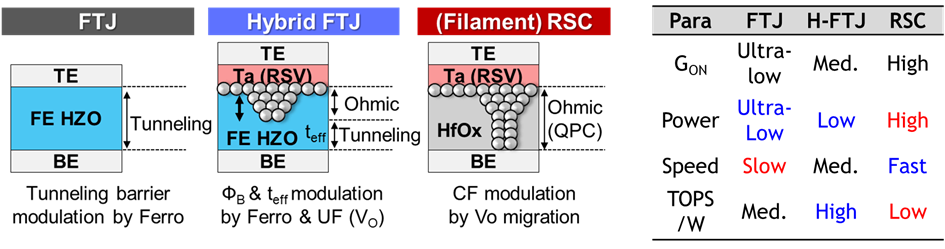
Fig. 1. Schematic illustration of the mechanism of FTJs, H-FTJs, and RSCs, and their corresponding key parameters.
Firstly, we analyzed the switching behavior of H-FTJs by splitting set and reset conditions (Fig. 2a). The HZO/Ta bi-layers exhibited an interesting non-volatile switching, which was not observed in the HZO only layers (Fig. 2b). This behavior is distinct from that of conventional FTJs or CF-based RSCs, and represents H-FTJ behaviors (Fig. 2c). In particular, the H-FTJs exhibited intermediate current levels between FTJs and RSCs, along with high on/off ratios.
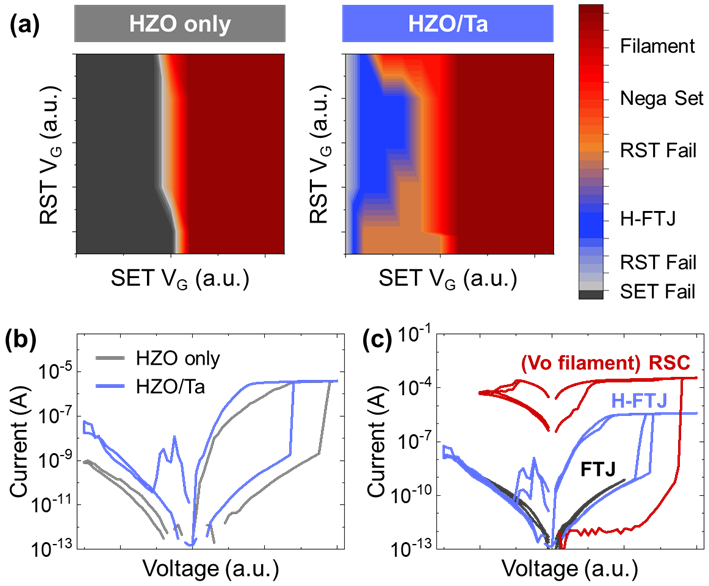
Fig. 2. (a) Contour maps for H-FTJ behaviors as a function of SET VG and RST VG. (b) I-V curves of HZO only layers and HZO/Ta bi-layers. (c) I-V curves of FTJ, H-FTJ, and RSC cells.
As a result, the H-FTJs showed optimum GON and high on/off ratios, which aligns with the target range for energy-efficient A-CiM applications (Fig. 3a). However, FTJs and RSCs failed to meet the target due to their ultra-low and high GON. In addition, we further improve the properties (GON = 1.6×10³ S/cm2, On/off ratio = 32,000) of H-FTJs by utilizing the interface engineering (Fig. 3b). As a result, our H-FTJs showed improved performances even in a nanoscale device compared to other recent studies on HZO-based FTJs.
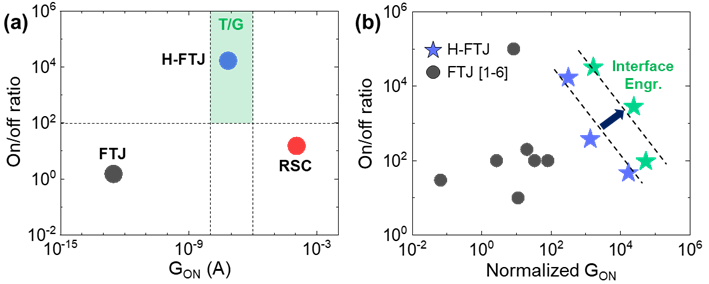
Fig. 3. (a) GON vs. On/off ratio of FTJ, H-FTJ, and RSC cells. (b) Comparison of normalized GON and On/off ratio with previously reported HZO-based FTJs. Engr. means engineering.
Then, we investigated the analog properties of H-FTJs and validated analog multiply-accumulate (MAC) operations in H-FTJ arrays. The conductance values of H-FTJ cells gradually increased with higher SET VG values by modulating the LFs and [VO] in the HZO layers. (Fig. 4a). Therefore, with program and verify methods, H-FTJs can provide multi-level conductance (up to 256-level) due to their high on/off ratios. In addition, we applied different input voltages and weight conductance to H-FTJ arrays. The measured MAC currents were well-matched with the ideal line with a high accuracy (91.9%) (Fig. 4b).
Lastly, we further investigated the inference performance of H-FTJ arrays for image classification (the CIFAR-10 with the VGG-8 model). The H-FTJ arrays showed higher energy efficiency than other FTJ and RSC arrays reported in the literature (Fig. 4c), due to their optimal GON and high on/off ratios (multi-leveling capabilities).
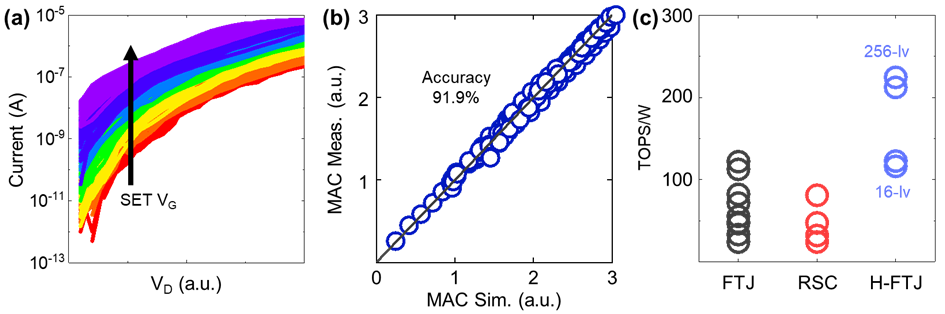
Fig. 4. (a) I-V curves of H-FTJs with different SET operations. (b) Experimental data of MAC currents in H-FTJ arrays. Meas. means measurement data and Sim. means simulation. (c) Comparison of H-FTJ arrays with other studies on FTJ and RSC arrays. TOPS/W is normalized by 8-bit precisions.
In summary, we demonstrated the hybridization of ferroelectric and resistive switching memory for energy-efficient A-CiM applications. The H-FTJs significantly improve the GON (1.6×10³ S/cm2) by modulating teff through the control of LFs in HZO layers. In addition, the H-FTJ arrays demonstrated accurate analog MAC operations with high energy efficiency (up to 224.4 TOPS/W). Our results can provide an efficient pathway for energy-efficient A-CiM for edge AI applications.
The Publication : Link

![[Summary] A Memristor-based In-Memory Computing SoC with Efficient Depthwise Convolution](https://mis-prod-koce-research-user-cdn-01-blob-ep.azureedge.net/web/blog/20260806/thumb_sEVmfv3K.20260806085519833.jpg)
![[Insights] Evolving Role of Emerging Memories in Next-Generation Computing](https://mis-prod-koce-research-user-cdn-01-blob-ep.azureedge.net/web/blog/20260806/thumb_NgJoNLYn.20260806080458980.jpg)
![[Summary] Electrical Characteristics of the 4F2 Vertical Gate (VG) DRAM integrated with Bit-Line Shielding (BLS) and Back Gate (BG) Transistor](https://mis-prod-koce-research-user-cdn-01-blob-ep.azureedge.net/web/blog/20260806/thumb_DOUurl5m.20260806080624234.png)