'%20fill='%23ea002c'/%3e%3cpath%20d='M31.44,109.48l7.92-9.71H33.72l-6.32,8.38h-.1V99.77H22.65v20.58h.28c2,0,4.4-.93,4.4-4.29v-4.73h.1l6.44,8.76h5.92Z'%20transform='translate(-5.29%20-72.33)'%20fill='%23ea002c'/%3e%3c/g%3e%3cg%3e%3cpath%20d='M39.63,77.72c-1.64.31-4.07,1.8-4.06,4.43,0,2.39,2,3.83,2,7a5.54,5.54,0,0,1-2.69,4.82c.57-.05,1.19-.08,1.87-.08a14.65,14.65,0,0,1,2.35.14l7.35-9A30.51,30.51,0,0,0,39.63,77.72Z'%20transform='translate(-5.29%20-72.33)'%20fill='%23ea002c'/%3e%3cpath%20d='M45.8,102.08c.93-1.44,1-3.74,1.12-6.07s.55-3.83,3.46-3.84c.65,0,1.26.09,2.38.09a17.2,17.2,0,0,0,8.8-2.46A30.54,30.54,0,0,0,46.41,85c-.41,1.18-3.67,10.23-3.92,11a11.32,11.32,0,0,1,1.32,1.93A21.12,21.12,0,0,1,45.8,102.08Z'%20transform='translate(-5.29%20-72.33)'%20fill='%23ea002c'/%3e%3cpath%20d='M30.28,94.69c-.38,0-.56-.25-.61-.68s-1.89-17.24-2.16-19.79c0-.37-.13-1-.13-1.3a.53.53,0,0,1,.55-.59c.87,0,5.62,1.11,10.66,4.64a5.37,5.37,0,0,0-4.07,5c0,2.77,2,4.29,2,7.07C36.54,93.59,31.35,94.69,30.28,94.69Z'%20transform='translate(-5.29%20-72.33)'%20fill='%23ff7a00'/%3e%3cpath%20d='M46.22,103.28a3.7,3.7,0,0,0,.23.51.52.52,0,0,0,.45.28,1.09,1.09,0,0,0,.42-.11l18.06-8.39c.33-.16,1-.45,1.18-.57a.56.56,0,0,0,.31-.49.58.58,0,0,0-.09-.3,18.5,18.5,0,0,0-4.25-3.76,19.07,19.07,0,0,1-9.63,2.78c-1.12,0-1.38-.08-2.14-.07-2.24,0-2.8,1-2.88,2.92,0,.37,0,.87,0,1.42C47.77,99.25,47.56,101.66,46.22,103.28Z'%20transform='translate(-5.29%20-72.33)'%20fill='%23ff7a00'/%3e%3c/g%3e%3cg%3e%3cpath%20d='M70.2,120.63c-1.7,4.61-3.89,5.2-5.78,5.2A5.55,5.55,0,0,1,62,125.3l.71-2.15a3.69,3.69,0,0,0,1.58.42c1.49,0,2.43-.84,3.26-3.44l-5.14-11.21a5.45,5.45,0,0,1,1.39-.21c1.65,0,2,1,2.43,2.06.36.85,2.7,6.51,2.7,6.51H69l2.72-8.36h2.81Z'%20transform='translate(-5.29%20-72.33)'%20fill='%23ff7a00'/%3e%3cpath%20d='M107.43,120.08l-3.93-5.72,3.85-5.6H104l-2.68,4.1-1.61-2.53c-.54-.83-1-1.66-2.25-1.63a2.46,2.46,0,0,0-.52,0,4.83,4.83,0,0,0-1.33.47c0,.06,1.89,2.68,3.65,5.22l-3.88,5.64h3.32l2.7-4.12,2.69,4.12Z'%20transform='translate(-5.29%20-72.33)'%20fill='%23ff7a00'/%3e%3cpath%20d='M76.84,112.6v7.49h2.81V112.3a3.79,3.79,0,0,1,2.26-1.09,2.16,2.16,0,0,1,2.2,2.41v6.47h2.81v-7.17a3.87,3.87,0,0,0-4.08-4.16,5.09,5.09,0,0,0-3.39,1.47A1.81,1.81,0,0,0,77.57,109a5.79,5.79,0,0,0-1,.14A14.85,14.85,0,0,1,76.84,112.6Z'%20transform='translate(-5.29%20-72.33)'%20fill='%23ff7a00'/%3e%3cg%3e%3cpath%20d='M93.2,105.54a1.74,1.74,0,1,1-1.74-1.69A1.71,1.71,0,0,1,93.2,105.54Z'%20transform='translate(-5.29%20-72.33)'%20fill='%23ff7a00'/%3e%3crect%20x='84.78'%20y='36.59'%20width='2.79'%20height='11.16'%20fill='%23ff7a00'/%3e%3c/g%3e%3cpath%20d='M53.44,110.2a5.74,5.74,0,0,1,3.62-1.49c2.19,0,3.8,1.14,3.8,3.91v7.47H57.94v-6.67a2,2,0,0,0-2-2.18,4.24,4.24,0,0,0-2.54,1.21v7.64h-2.9v-17h.62a2.22,2.22,0,0,1,2.28,2.35Z'%20transform='translate(-5.29%20-72.33)'%20fill='%23ff7a00'/%3e%3c/g%3e%3c/g%3e%3c/svg%3e)
[Summary] Opposing Mean Error Compensation for Accuracy Enhancement in Analog Compute-in-Memory With Resistive Switching Devices
Our study has been accepted for publication in the prestigious IEEE Transactions on Electron Devices. We conducted a collaborative simulation-based study with Georgia Tech to enhance the computational accuracy of Analog Compute-in-Memory systems using Resistive Synapse Cells (HfOx/Ta). Our research focused on significantly improving AI model accuracy by simply altering the weight data input method, without the need for developing new devices. In this blog post, we'll delve into the details of our study.
As the complexity of AI models continues to grow, the need for new hardware architectures that enable energy-efficient computation has become increasingly important. One promising solution is Analog Compute-in-Memory technology, which offers the potential for low-power, high-speed processing. This technology can be implemented using resistive switching cells, which store and process data simultaneously. However, a significant challenge arises from the conductance variation in these resistive switching cells, which can lead to reduced accuracy in AI models. Our research addresses this issue by presenting an innovative methodology that improves model accuracy without the need for cell engineering.
We introduced an "Opposing Mean Error Compensation (OMEC)" characteristic of AI models in this study. When one cell has a conductance error, another cell can be adjusted to have a conductance error in the opposite direction to compensate for it. Figure 1 illustrates a real-world example of OMEC. Fig. 1(a) shows the representation of conductance variation in resistive cells in terms of mean error and standard deviation. Fig. 1(b) displays the actual conductance variation of cells for two different schemes. Both Scheme 1 and Scheme 2 have nearly identical standard deviation values, and their mean errors are similar in absolute terms. The key difference is that the mean error in Scheme 1 is predominantly positive, while in Scheme 2, the mean error is evenly distributed between positive and negative values. Fig. 1(c) and 3(d) show the histograms of MAC errors when performing MAC operations for Schemes 1 and 2, respectively. In Scheme 1, the MAC error persists even after more than 4000 MAC operations, whereas in Scheme 2, the MAC error nearly disappears. As a result, the AI model accuracy for Scheme 1 is 82.78%, while for Scheme 2, it is higher at 91.12%. In other words, although the conductance variations are similar for Schemes 1 and 2, Scheme 2 achieves higher accuracy due to the OMEC.
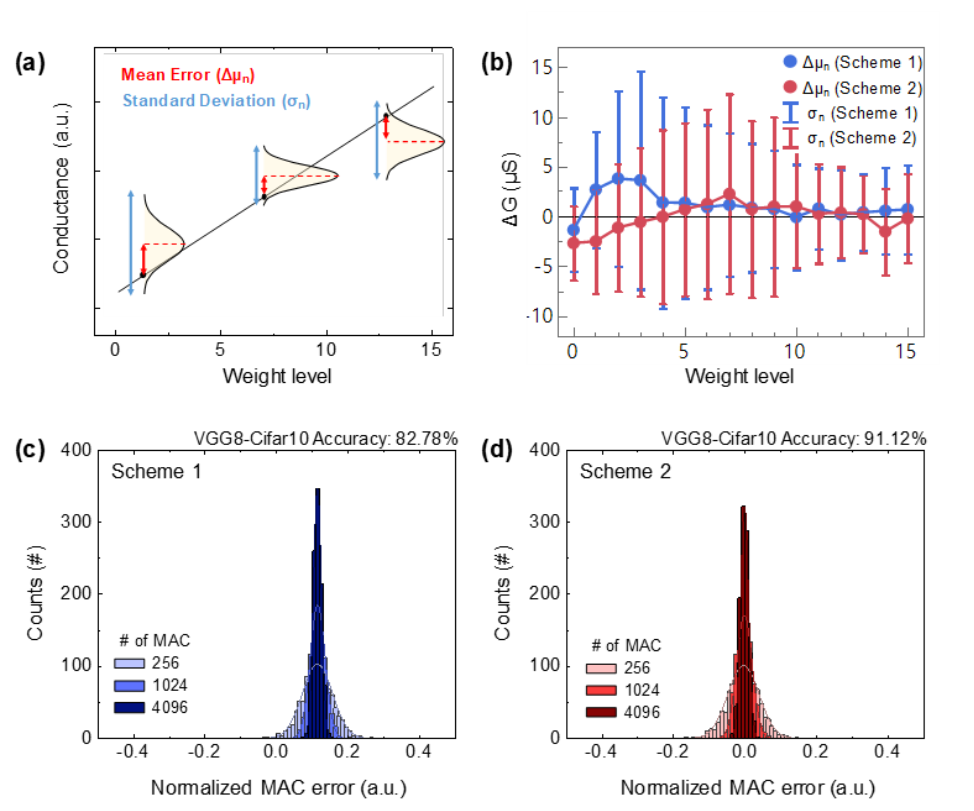
Fig. 1. (a) The illustration explaining how Mean Error and Standard Deviation metrics are defined. (b) The graph showing the mean error and standard deviation of cell conductance for different weight levels across two different schemes. Histogram of normalized MAC errors for (c) Scheme 1 and (d) Scheme 2.
By utilizing OMEC, we present a method to dramatically improve accuracy. By understanding the conductance distribution characteristics of each cell level in advance, we can reflect this in the cell writing process to enhance the accuracy of the AI model. Figure 2 demonstrates cases where accuracy drops due to cell variation and how OMEC has been used to improve accuracy in these scenarios. By intentionally writing a value that is either one level higher or lower into the cells for a certain proportion of the weight data, we can compensate for the mean error (Fig. 2 (a)-(c)). Accuracy improvements were observed in all cases, with a particularly dramatic improvement in case 3, where accuracy increased from 12.6% to 90.7%.
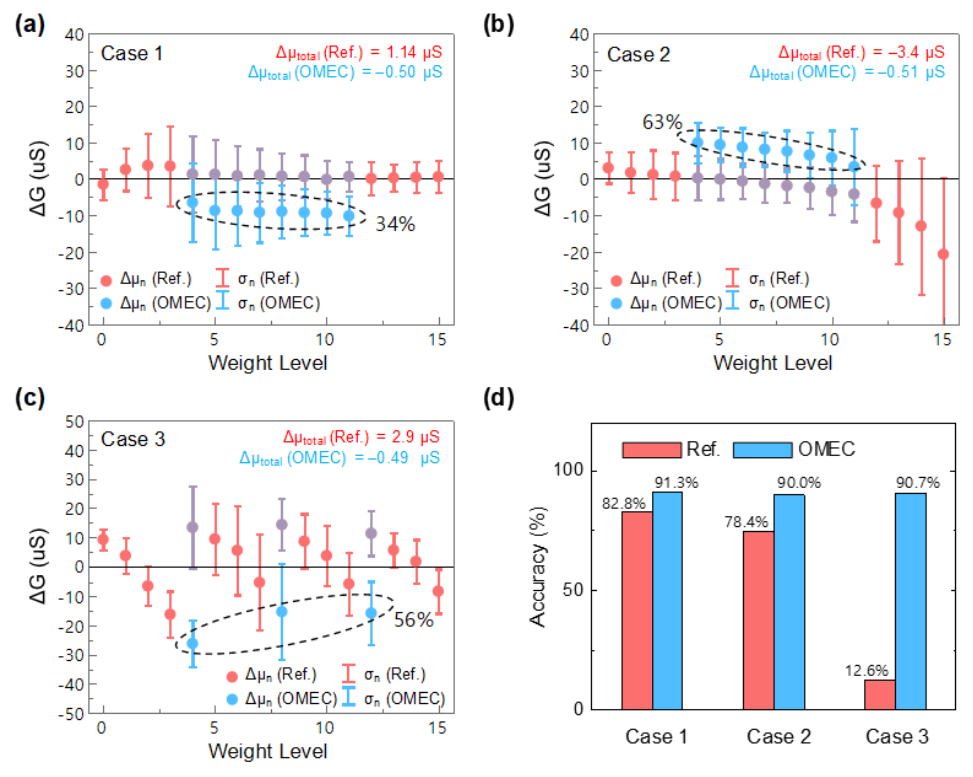
Fig. 2. Accuracy enhancement with the application of OMEC across three different real cell data scenarios. (a)-(c) illustrate the conductance variations at different levels before and after the implementation of OMEC for Case 1, Case 2, and Case 3, respectively. (d) shows the AI model's accuracy prior to and following the application of OMEC.
The significance of our research lies in understanding and leveraging the characteristics of AI models in relation to cell variation to relax the requirements of the cells. While previous studies have proposed noise-aware training methods that involve re-training or fine-tuning AI models to account for cell variation, these approaches can be prohibitively resource-intensive and time-consuming, especially for large models. In contrast, our method directly modifies the weights by understanding the AI model's characteristics, allowing for a straightforward application without consuming extensive computing resources.
For more detailed information on this study, please refer to the publication.
The Publication : Link

![[Summary] A Memristor-based In-Memory Computing SoC with Efficient Depthwise Convolution](https://mis-prod-koce-research-user-cdn-01-blob-ep.azureedge.net/web/blog/20260806/thumb_sEVmfv3K.20260806085519833.jpg)
![[Insights] Evolving Role of Emerging Memories in Next-Generation Computing](https://mis-prod-koce-research-user-cdn-01-blob-ep.azureedge.net/web/blog/20260806/thumb_NgJoNLYn.20260806080458980.jpg)
![[Summary] Electrical Characteristics of the 4F2 Vertical Gate (VG) DRAM integrated with Bit-Line Shielding (BLS) and Back Gate (BG) Transistor](https://mis-prod-koce-research-user-cdn-01-blob-ep.azureedge.net/web/blog/20260806/thumb_DOUurl5m.20260806080624234.png)