'%20fill='%23ea002c'/%3e%3cpath%20d='M31.44,109.48l7.92-9.71H33.72l-6.32,8.38h-.1V99.77H22.65v20.58h.28c2,0,4.4-.93,4.4-4.29v-4.73h.1l6.44,8.76h5.92Z'%20transform='translate(-5.29%20-72.33)'%20fill='%23ea002c'/%3e%3c/g%3e%3cg%3e%3cpath%20d='M39.63,77.72c-1.64.31-4.07,1.8-4.06,4.43,0,2.39,2,3.83,2,7a5.54,5.54,0,0,1-2.69,4.82c.57-.05,1.19-.08,1.87-.08a14.65,14.65,0,0,1,2.35.14l7.35-9A30.51,30.51,0,0,0,39.63,77.72Z'%20transform='translate(-5.29%20-72.33)'%20fill='%23ea002c'/%3e%3cpath%20d='M45.8,102.08c.93-1.44,1-3.74,1.12-6.07s.55-3.83,3.46-3.84c.65,0,1.26.09,2.38.09a17.2,17.2,0,0,0,8.8-2.46A30.54,30.54,0,0,0,46.41,85c-.41,1.18-3.67,10.23-3.92,11a11.32,11.32,0,0,1,1.32,1.93A21.12,21.12,0,0,1,45.8,102.08Z'%20transform='translate(-5.29%20-72.33)'%20fill='%23ea002c'/%3e%3cpath%20d='M30.28,94.69c-.38,0-.56-.25-.61-.68s-1.89-17.24-2.16-19.79c0-.37-.13-1-.13-1.3a.53.53,0,0,1,.55-.59c.87,0,5.62,1.11,10.66,4.64a5.37,5.37,0,0,0-4.07,5c0,2.77,2,4.29,2,7.07C36.54,93.59,31.35,94.69,30.28,94.69Z'%20transform='translate(-5.29%20-72.33)'%20fill='%23ff7a00'/%3e%3cpath%20d='M46.22,103.28a3.7,3.7,0,0,0,.23.51.52.52,0,0,0,.45.28,1.09,1.09,0,0,0,.42-.11l18.06-8.39c.33-.16,1-.45,1.18-.57a.56.56,0,0,0,.31-.49.58.58,0,0,0-.09-.3,18.5,18.5,0,0,0-4.25-3.76,19.07,19.07,0,0,1-9.63,2.78c-1.12,0-1.38-.08-2.14-.07-2.24,0-2.8,1-2.88,2.92,0,.37,0,.87,0,1.42C47.77,99.25,47.56,101.66,46.22,103.28Z'%20transform='translate(-5.29%20-72.33)'%20fill='%23ff7a00'/%3e%3c/g%3e%3cg%3e%3cpath%20d='M70.2,120.63c-1.7,4.61-3.89,5.2-5.78,5.2A5.55,5.55,0,0,1,62,125.3l.71-2.15a3.69,3.69,0,0,0,1.58.42c1.49,0,2.43-.84,3.26-3.44l-5.14-11.21a5.45,5.45,0,0,1,1.39-.21c1.65,0,2,1,2.43,2.06.36.85,2.7,6.51,2.7,6.51H69l2.72-8.36h2.81Z'%20transform='translate(-5.29%20-72.33)'%20fill='%23ff7a00'/%3e%3cpath%20d='M107.43,120.08l-3.93-5.72,3.85-5.6H104l-2.68,4.1-1.61-2.53c-.54-.83-1-1.66-2.25-1.63a2.46,2.46,0,0,0-.52,0,4.83,4.83,0,0,0-1.33.47c0,.06,1.89,2.68,3.65,5.22l-3.88,5.64h3.32l2.7-4.12,2.69,4.12Z'%20transform='translate(-5.29%20-72.33)'%20fill='%23ff7a00'/%3e%3cpath%20d='M76.84,112.6v7.49h2.81V112.3a3.79,3.79,0,0,1,2.26-1.09,2.16,2.16,0,0,1,2.2,2.41v6.47h2.81v-7.17a3.87,3.87,0,0,0-4.08-4.16,5.09,5.09,0,0,0-3.39,1.47A1.81,1.81,0,0,0,77.57,109a5.79,5.79,0,0,0-1,.14A14.85,14.85,0,0,1,76.84,112.6Z'%20transform='translate(-5.29%20-72.33)'%20fill='%23ff7a00'/%3e%3cg%3e%3cpath%20d='M93.2,105.54a1.74,1.74,0,1,1-1.74-1.69A1.71,1.71,0,0,1,93.2,105.54Z'%20transform='translate(-5.29%20-72.33)'%20fill='%23ff7a00'/%3e%3crect%20x='84.78'%20y='36.59'%20width='2.79'%20height='11.16'%20fill='%23ff7a00'/%3e%3c/g%3e%3cpath%20d='M53.44,110.2a5.74,5.74,0,0,1,3.62-1.49c2.19,0,3.8,1.14,3.8,3.91v7.47H57.94v-6.67a2,2,0,0,0-2-2.18,4.24,4.24,0,0,0-2.54,1.21v7.64h-2.9v-17h.62a2.22,2.22,0,0,1,2.28,2.35Z'%20transform='translate(-5.29%20-72.33)'%20fill='%23ff7a00'/%3e%3c/g%3e%3c/g%3e%3c/svg%3e)
[Summary] Improvement of MAC Accuracy using Oxygen Diffusion Barriers in Resistive Synaptic Cell Arrays
Analog computation-in-memory (A-CiM) using an emerging non-volatile memory has been extensively studied in order to utilize analog dot-product in memory cell arrays. Among various emerging non-volatile memories, HfO2-based resistive synaptic cells (RSCs) are one of the potential candidates due to their high CMOS compatibility. However, metal oxide-based RSC arrays have inherent issues, such as reliability and variations.
In this study, we revealed that the control of oxygen diffusion is key to improve the reliability of HfO2-based RSC arrays. The insertion of oxygen diffusion barriers suppress the reset failures from the negative-set (Fig. 1a), resulting in reliable 16-level weight operations of RSC arrays with enhanced retention times. In addition, we fabricated 256k cell 1T1R cross-bar RSC arrays (Fig. 1b), and confirmed their stable multiply–accumulate (MAC) operations with over 90% accuracy.
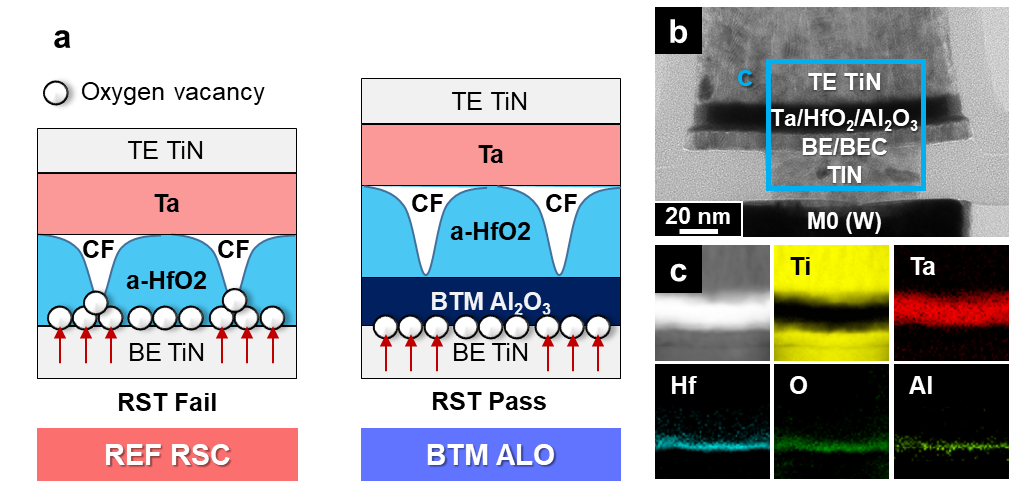
Fig. 1. (a) Schematic illustration of resistive synaptic layers without bottom Al2O3 (REF RSC) and with bottom Al2O3 (BTM ALO). (b) TEM image and (c) EELS elemental mapping images of the BTM ALO device.
Fig. 2 shows pulse measurement data of the samples. The traces of conductance levels as a function of ERS Vs pulses during the RST process after LRS PGM indicate that the negative-set is prevented by the addition of bottom Al2O3 layers (Fig. 2a). The REF RSC devices, without bottom Al2O3 layers, are vulnerable to the negative-set during ERS operations, particularly after high conductance PGM operations (Fig. 2b). On the other hand, the BTM ALO devices are resistant to the negative-set, showing the reliable PGM/ERS properties for 4-bit weights (Fig. 2c).
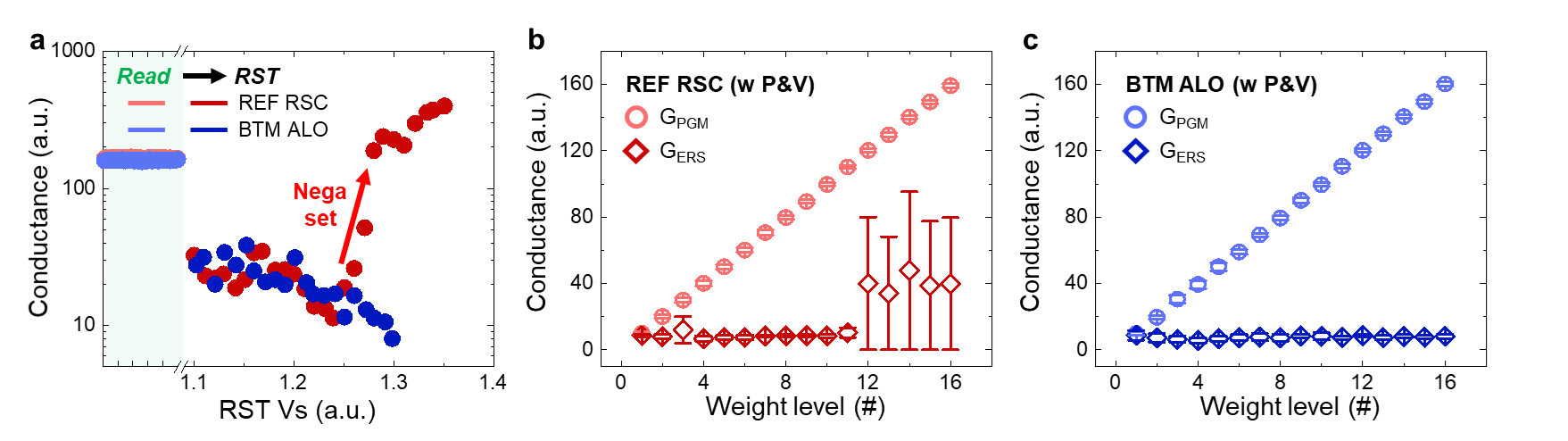
Fig. 2. (a) The RST behaviors of the samples. (b,c) The 16-level PGM/ERS conductance values: (b) REF RSC and (c) BTM ALO devices.
To demonstrate MAC operations, we defined a target pattern map and programmed RSC sub-arrays (256 × 16) (Fig. 3a). Then, we verified MAC operations of RSC arrays by using Ohm’s law and Kirchhoff's law (MAC currents [IMAC] = ∑ G × VIn) (Fig. 3b). The MAC operations of REF RSC arrays showed significant deviations from simulations due to the negative-set induced hard breakdown and poor retention properties. However, the BTM ALO arrays displayed reliable MAC operations. Therefore, the BTM ALO arrays exhibited higher MAC accuracy (94.3 ± 6.5%) than the REF RSC arrays (79.5 ± 18.5%) (Fig. 3c).
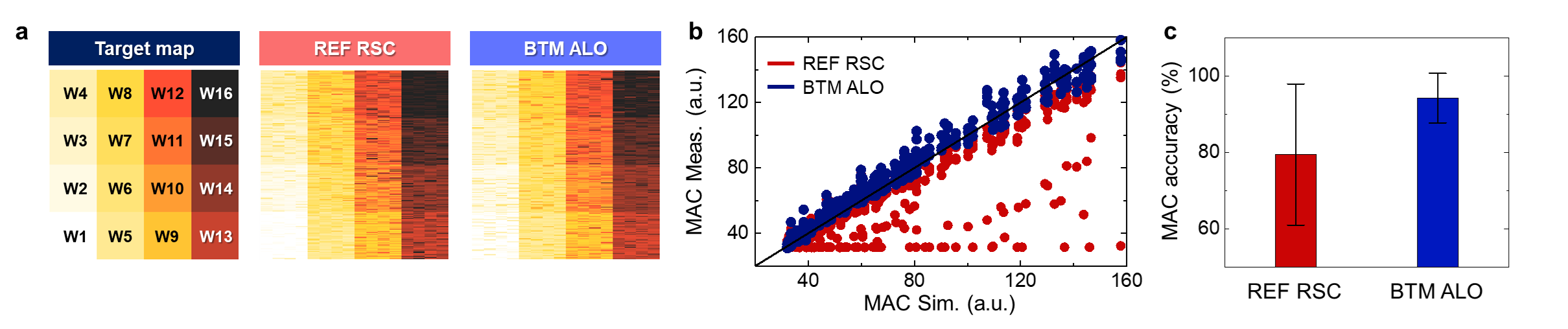
Fig. 3. (a) Weight pattern map for MAC operations. (b) Experimental measurement of MAC operations. (c) MAC accuracy of the samples.
In summary, we demonstrated the improvement of MAC accuracy by using oxygen diffusion barriers in RSC arrays. We revealed that the oxygen diffusion barriers prevent the negative-set, thereby inducing reliable weight PGM and ERS operations of HfO2-based RSCs with 16-level analog properties. In addition, we developed fully integrated 256k cell 1T1R cross-bar RSC arrays, and confirmed the improved MAC accuracy (~94%) of the BTM ALO arrays. These results can provide a guide for the optimization of large-scale full chip integration of RSC array-based A-CiM applications.
The Publication : Link

![[Summary] A Memristor-based In-Memory Computing SoC with Efficient Depthwise Convolution](https://mis-prod-koce-research-user-cdn-01-blob-ep.azureedge.net/web/blog/20260806/thumb_sEVmfv3K.20260806085519833.jpg)
![[Insights] Evolving Role of Emerging Memories in Next-Generation Computing](https://mis-prod-koce-research-user-cdn-01-blob-ep.azureedge.net/web/blog/20260806/thumb_NgJoNLYn.20260806080458980.jpg)
![[Summary] Electrical Characteristics of the 4F2 Vertical Gate (VG) DRAM integrated with Bit-Line Shielding (BLS) and Back Gate (BG) Transistor](https://mis-prod-koce-research-user-cdn-01-blob-ep.azureedge.net/web/blog/20260806/thumb_DOUurl5m.20260806080624234.png)