'%20fill='%23ea002c'/%3e%3cpath%20d='M31.44,109.48l7.92-9.71H33.72l-6.32,8.38h-.1V99.77H22.65v20.58h.28c2,0,4.4-.93,4.4-4.29v-4.73h.1l6.44,8.76h5.92Z'%20transform='translate(-5.29%20-72.33)'%20fill='%23ea002c'/%3e%3c/g%3e%3cg%3e%3cpath%20d='M39.63,77.72c-1.64.31-4.07,1.8-4.06,4.43,0,2.39,2,3.83,2,7a5.54,5.54,0,0,1-2.69,4.82c.57-.05,1.19-.08,1.87-.08a14.65,14.65,0,0,1,2.35.14l7.35-9A30.51,30.51,0,0,0,39.63,77.72Z'%20transform='translate(-5.29%20-72.33)'%20fill='%23ea002c'/%3e%3cpath%20d='M45.8,102.08c.93-1.44,1-3.74,1.12-6.07s.55-3.83,3.46-3.84c.65,0,1.26.09,2.38.09a17.2,17.2,0,0,0,8.8-2.46A30.54,30.54,0,0,0,46.41,85c-.41,1.18-3.67,10.23-3.92,11a11.32,11.32,0,0,1,1.32,1.93A21.12,21.12,0,0,1,45.8,102.08Z'%20transform='translate(-5.29%20-72.33)'%20fill='%23ea002c'/%3e%3cpath%20d='M30.28,94.69c-.38,0-.56-.25-.61-.68s-1.89-17.24-2.16-19.79c0-.37-.13-1-.13-1.3a.53.53,0,0,1,.55-.59c.87,0,5.62,1.11,10.66,4.64a5.37,5.37,0,0,0-4.07,5c0,2.77,2,4.29,2,7.07C36.54,93.59,31.35,94.69,30.28,94.69Z'%20transform='translate(-5.29%20-72.33)'%20fill='%23ff7a00'/%3e%3cpath%20d='M46.22,103.28a3.7,3.7,0,0,0,.23.51.52.52,0,0,0,.45.28,1.09,1.09,0,0,0,.42-.11l18.06-8.39c.33-.16,1-.45,1.18-.57a.56.56,0,0,0,.31-.49.58.58,0,0,0-.09-.3,18.5,18.5,0,0,0-4.25-3.76,19.07,19.07,0,0,1-9.63,2.78c-1.12,0-1.38-.08-2.14-.07-2.24,0-2.8,1-2.88,2.92,0,.37,0,.87,0,1.42C47.77,99.25,47.56,101.66,46.22,103.28Z'%20transform='translate(-5.29%20-72.33)'%20fill='%23ff7a00'/%3e%3c/g%3e%3cg%3e%3cpath%20d='M70.2,120.63c-1.7,4.61-3.89,5.2-5.78,5.2A5.55,5.55,0,0,1,62,125.3l.71-2.15a3.69,3.69,0,0,0,1.58.42c1.49,0,2.43-.84,3.26-3.44l-5.14-11.21a5.45,5.45,0,0,1,1.39-.21c1.65,0,2,1,2.43,2.06.36.85,2.7,6.51,2.7,6.51H69l2.72-8.36h2.81Z'%20transform='translate(-5.29%20-72.33)'%20fill='%23ff7a00'/%3e%3cpath%20d='M107.43,120.08l-3.93-5.72,3.85-5.6H104l-2.68,4.1-1.61-2.53c-.54-.83-1-1.66-2.25-1.63a2.46,2.46,0,0,0-.52,0,4.83,4.83,0,0,0-1.33.47c0,.06,1.89,2.68,3.65,5.22l-3.88,5.64h3.32l2.7-4.12,2.69,4.12Z'%20transform='translate(-5.29%20-72.33)'%20fill='%23ff7a00'/%3e%3cpath%20d='M76.84,112.6v7.49h2.81V112.3a3.79,3.79,0,0,1,2.26-1.09,2.16,2.16,0,0,1,2.2,2.41v6.47h2.81v-7.17a3.87,3.87,0,0,0-4.08-4.16,5.09,5.09,0,0,0-3.39,1.47A1.81,1.81,0,0,0,77.57,109a5.79,5.79,0,0,0-1,.14A14.85,14.85,0,0,1,76.84,112.6Z'%20transform='translate(-5.29%20-72.33)'%20fill='%23ff7a00'/%3e%3cg%3e%3cpath%20d='M93.2,105.54a1.74,1.74,0,1,1-1.74-1.69A1.71,1.71,0,0,1,93.2,105.54Z'%20transform='translate(-5.29%20-72.33)'%20fill='%23ff7a00'/%3e%3crect%20x='84.78'%20y='36.59'%20width='2.79'%20height='11.16'%20fill='%23ff7a00'/%3e%3c/g%3e%3cpath%20d='M53.44,110.2a5.74,5.74,0,0,1,3.62-1.49c2.19,0,3.8,1.14,3.8,3.91v7.47H57.94v-6.67a2,2,0,0,0-2-2.18,4.24,4.24,0,0,0-2.54,1.21v7.64h-2.9v-17h.62a2.22,2.22,0,0,1,2.28,2.35Z'%20transform='translate(-5.29%20-72.33)'%20fill='%23ff7a00'/%3e%3c/g%3e%3c/g%3e%3c/svg%3e)
[Summary] Realistic Noise-aware Training as a Component of the Holistic ACiM Development Platform
Analog Computation-in-Memory (A-CiM) can accelerate the large-scale neural network (NN) AI model by eliminating von-Neumann bottleneck by processing calculation inside a memory. Additionally, the Resistive Synaptic Cell (RSC) is a promising memory device for a primitive element of ACiM due to its low operational power. Meanwhile, the analog nature of the calculation hinders the performance of ACiM due to non-ideal factors, such as the failure of the RSC device. In this study, a new tuning method will be introduced that integrates realistic device variation of RSC into the training process to endow a NN with robustness to the variation, ensuring high inference accuracy.
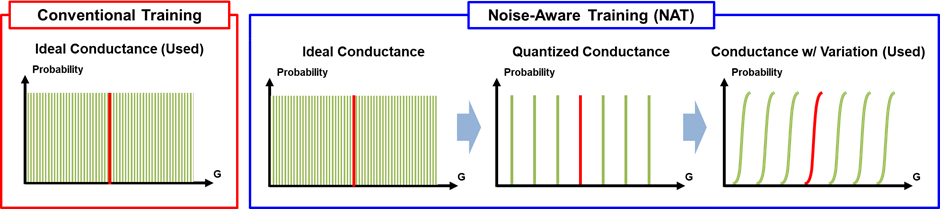
Fig. 1. Comparison between conventional training and conventional Noise-aware training in terms of available conductance states and probability.
Fig. 1 summarizes the difference between conventional training and Noise-aware training (NAT) in terms of the RSC conductance. In conventional training, it is assumed that the conductance value is expressed as a real number with 100% probability. On the other hand, NAT expresses conductance value as the sum of random noise and the quantized conductances, which can be correlated with the conductance of real RSC device. The noise has been assumed to follow a Gaussian distribution in previous studies. In this study, we utilized realistic device variation of real RSC device with NAT to enhance the inference accuracy of NN
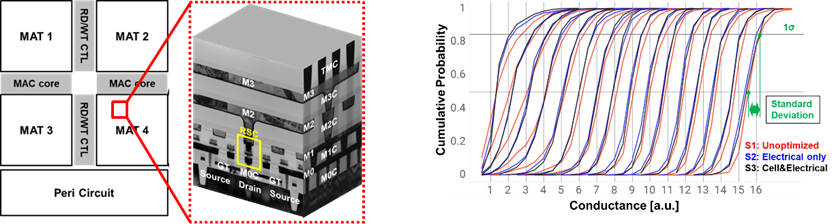
Fig. 2. (a) Schematic of RSC array with core and peripheral circuits, including the enlarged TEM image of the array. (b) Cumulative probability distribution of normalized RSC conductances in the array with 16 distinct target conductances and non-ideal factor combinations.
Three RSC device arrays (Fig. 2a) were fabricated and measured under three combinations of non-ideal factors: Unoptimized array (S1), array with only optimized electrical methods (S2), and array with optimized cell and electrical methods (S3). Each RSC in the array was categorized into 16 target conductances, and written using closed-loop pulses and validation methods, followed by readout of actual conductances. Fig. 2b shows the cumulative probability distribution of 16 RSC conductances in the array.
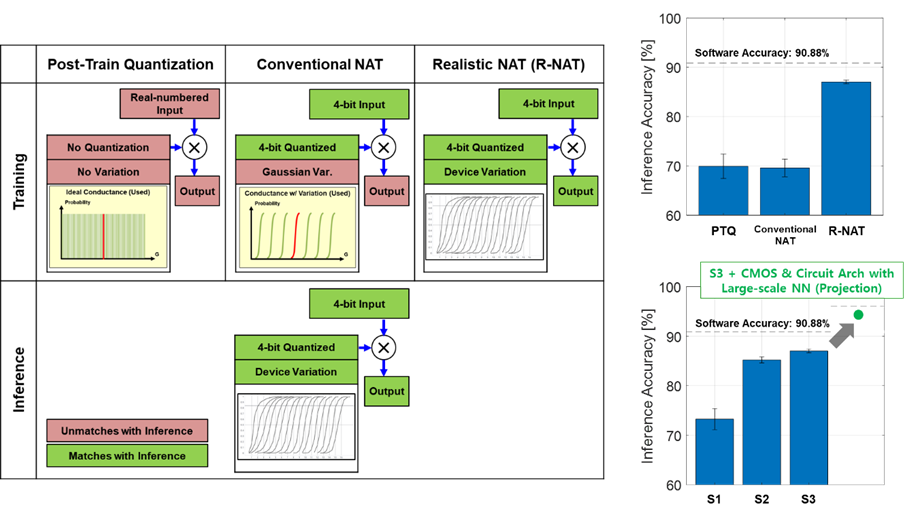
Fig. 3. (a) Three different training methods differ in terms of precisions and noise type. R-NAT is the method used in this study. (b) Inference accuracies with different training methods (c) Inference accuracies with different RSC conductacnes in Fig. 2b representing the different non-ideal factor combinations.
Fig. 3a compares three different training methods: Post-Train Quantization, conventional NAT (c-NAT), and the proposed Realistic-NAT (R-NAT). The R-NAT reflects real device variation which is hard to be modeled by a Gaussian distribution (c-NAT). Inference accuracy from VGG9 NN with CIFAR10 images were evaluated with different training methods and non-ideal factor combinations whose results are depicted as Fig. 3b and Fig. 3c, respectively. The results show that reflecting real device variation is essential to maximize the performance of ACiM, and conventional device optimization is also important to maximizing the accuracy.
In summary, we developed the R-NAT which seamlessly integrates realistic device variation into NAT. The inference accuracy results suggest that realistic device variation is important for maximizing accuracy, which usually realized by large number of devices. It is also important that holistic methodology is still important in terms of maximizing performance of ACiM. The further inference accuracy gap is also reducible by optimizing the CMOS platform and circuit architecture, which will be our future work.
The Publication : Link

![[Summary] A Memristor-based In-Memory Computing SoC with Efficient Depthwise Convolution](https://mis-prod-koce-research-user-cdn-01-blob-ep.azureedge.net/web/blog/20260806/thumb_sEVmfv3K.20260806085519833.jpg)
![[Insights] Evolving Role of Emerging Memories in Next-Generation Computing](https://mis-prod-koce-research-user-cdn-01-blob-ep.azureedge.net/web/blog/20260806/thumb_NgJoNLYn.20260806080458980.jpg)
![[Summary] Electrical Characteristics of the 4F2 Vertical Gate (VG) DRAM integrated with Bit-Line Shielding (BLS) and Back Gate (BG) Transistor](https://mis-prod-koce-research-user-cdn-01-blob-ep.azureedge.net/web/blog/20260806/thumb_DOUurl5m.20260806080624234.png)