'%20fill='%23ea002c'/%3e%3cpath%20d='M31.44,109.48l7.92-9.71H33.72l-6.32,8.38h-.1V99.77H22.65v20.58h.28c2,0,4.4-.93,4.4-4.29v-4.73h.1l6.44,8.76h5.92Z'%20transform='translate(-5.29%20-72.33)'%20fill='%23ea002c'/%3e%3c/g%3e%3cg%3e%3cpath%20d='M39.63,77.72c-1.64.31-4.07,1.8-4.06,4.43,0,2.39,2,3.83,2,7a5.54,5.54,0,0,1-2.69,4.82c.57-.05,1.19-.08,1.87-.08a14.65,14.65,0,0,1,2.35.14l7.35-9A30.51,30.51,0,0,0,39.63,77.72Z'%20transform='translate(-5.29%20-72.33)'%20fill='%23ea002c'/%3e%3cpath%20d='M45.8,102.08c.93-1.44,1-3.74,1.12-6.07s.55-3.83,3.46-3.84c.65,0,1.26.09,2.38.09a17.2,17.2,0,0,0,8.8-2.46A30.54,30.54,0,0,0,46.41,85c-.41,1.18-3.67,10.23-3.92,11a11.32,11.32,0,0,1,1.32,1.93A21.12,21.12,0,0,1,45.8,102.08Z'%20transform='translate(-5.29%20-72.33)'%20fill='%23ea002c'/%3e%3cpath%20d='M30.28,94.69c-.38,0-.56-.25-.61-.68s-1.89-17.24-2.16-19.79c0-.37-.13-1-.13-1.3a.53.53,0,0,1,.55-.59c.87,0,5.62,1.11,10.66,4.64a5.37,5.37,0,0,0-4.07,5c0,2.77,2,4.29,2,7.07C36.54,93.59,31.35,94.69,30.28,94.69Z'%20transform='translate(-5.29%20-72.33)'%20fill='%23ff7a00'/%3e%3cpath%20d='M46.22,103.28a3.7,3.7,0,0,0,.23.51.52.52,0,0,0,.45.28,1.09,1.09,0,0,0,.42-.11l18.06-8.39c.33-.16,1-.45,1.18-.57a.56.56,0,0,0,.31-.49.58.58,0,0,0-.09-.3,18.5,18.5,0,0,0-4.25-3.76,19.07,19.07,0,0,1-9.63,2.78c-1.12,0-1.38-.08-2.14-.07-2.24,0-2.8,1-2.88,2.92,0,.37,0,.87,0,1.42C47.77,99.25,47.56,101.66,46.22,103.28Z'%20transform='translate(-5.29%20-72.33)'%20fill='%23ff7a00'/%3e%3c/g%3e%3cg%3e%3cpath%20d='M70.2,120.63c-1.7,4.61-3.89,5.2-5.78,5.2A5.55,5.55,0,0,1,62,125.3l.71-2.15a3.69,3.69,0,0,0,1.58.42c1.49,0,2.43-.84,3.26-3.44l-5.14-11.21a5.45,5.45,0,0,1,1.39-.21c1.65,0,2,1,2.43,2.06.36.85,2.7,6.51,2.7,6.51H69l2.72-8.36h2.81Z'%20transform='translate(-5.29%20-72.33)'%20fill='%23ff7a00'/%3e%3cpath%20d='M107.43,120.08l-3.93-5.72,3.85-5.6H104l-2.68,4.1-1.61-2.53c-.54-.83-1-1.66-2.25-1.63a2.46,2.46,0,0,0-.52,0,4.83,4.83,0,0,0-1.33.47c0,.06,1.89,2.68,3.65,5.22l-3.88,5.64h3.32l2.7-4.12,2.69,4.12Z'%20transform='translate(-5.29%20-72.33)'%20fill='%23ff7a00'/%3e%3cpath%20d='M76.84,112.6v7.49h2.81V112.3a3.79,3.79,0,0,1,2.26-1.09,2.16,2.16,0,0,1,2.2,2.41v6.47h2.81v-7.17a3.87,3.87,0,0,0-4.08-4.16,5.09,5.09,0,0,0-3.39,1.47A1.81,1.81,0,0,0,77.57,109a5.79,5.79,0,0,0-1,.14A14.85,14.85,0,0,1,76.84,112.6Z'%20transform='translate(-5.29%20-72.33)'%20fill='%23ff7a00'/%3e%3cg%3e%3cpath%20d='M93.2,105.54a1.74,1.74,0,1,1-1.74-1.69A1.71,1.71,0,0,1,93.2,105.54Z'%20transform='translate(-5.29%20-72.33)'%20fill='%23ff7a00'/%3e%3crect%20x='84.78'%20y='36.59'%20width='2.79'%20height='11.16'%20fill='%23ff7a00'/%3e%3c/g%3e%3cpath%20d='M53.44,110.2a5.74,5.74,0,0,1,3.62-1.49c2.19,0,3.8,1.14,3.8,3.91v7.47H57.94v-6.67a2,2,0,0,0-2-2.18,4.24,4.24,0,0,0-2.54,1.21v7.64h-2.9v-17h.62a2.22,2.22,0,0,1,2.28,2.35Z'%20transform='translate(-5.29%20-72.33)'%20fill='%23ff7a00'/%3e%3c/g%3e%3c/g%3e%3c/svg%3e)
[Insight] Opportunities and Challenges of Emerging Memory in the Era of All About Data
All over the world, our lives have forever changed during the Covid-19 pandemic. We have become increasingly reliant on achieving social closeness with various technologies, while physical distancing has been enforced. Now our daily routines are virtually connected to the global world through countless devices. As a result, all of these have been generating an unprecedented amount of data. For example, AI applications have been intimately inserted into our daily lives, and new applications such as Metaverse, which have previously been only the subject in sci-fi novels, have become reality. In our industry, we are naturally proud that advanced semiconductors are the backbone of these impactful technologies. However, it is also true that these new applications pose historical challenges to semiconductor scaling, and, at the same time, create opportunities for semiconductor technologies to move faster and more efficient in terms of power-performance-area-cost.
Memory innovation has been recognized as one of the key solutions to address the challenges in the era of “All about data”. Not only is it important that memory technologies deliver all the traditional values such as high performance, lower power consumption, lower cost, and higher capacity, but also offer smarter solutions to effectively eliminate issues inherent to the so-called memory wall. In addition, the explosion of data and technology scaling challenges open up opportunities toward more memory-centric computing and distributed system architectures.
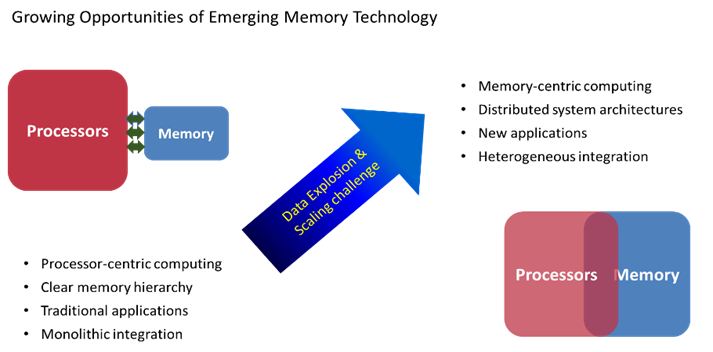
We believe that memory innovation toward next generation computing is a journey which will take several steps.
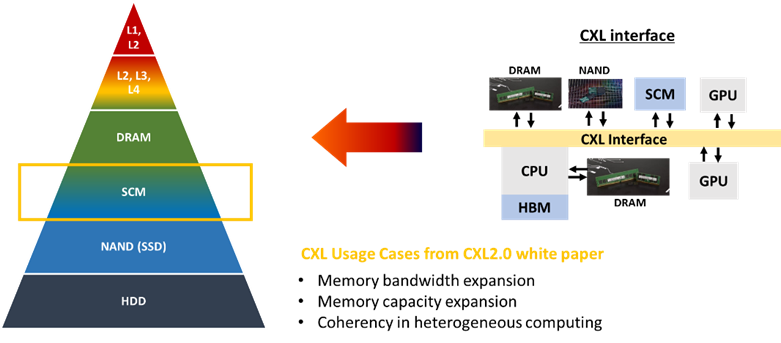
This journey starts with developing newly emerging memory technologies to support new application, and continues on the path to ultimately breaking down the memory-compute boundaries. The introduction of new interfaces such as Compute-Express-Link (CXL) can offer many opportunities for emerging memories in storage class memory. Our starting point consists of several research options including chalcogenide-based memories for emerging memory toward better performance and process simplicity, going beyond existing industry solutions such as 3DxP.
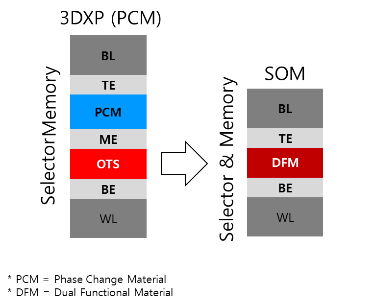
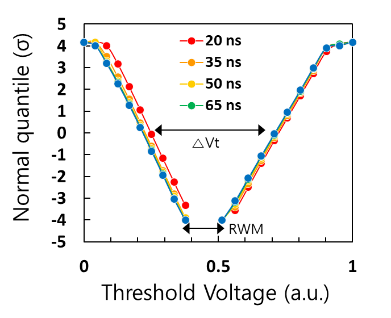
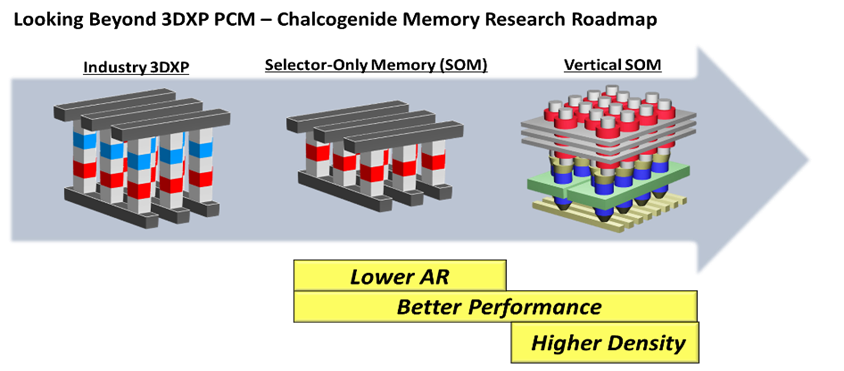
Industry 3DXP products have been introduced by Intel and Micron, and have been implemented in several system solutions. However, PCM (phase-change memory) suffers from slow write speed and endurance, resulting from its fundamental device characteristics. These limitations pose several challenges in system applications, although significant progress has been made in recent years. Furthermore, the high aspect ratio of cross-point PCRAM-based cells has been one of the key challenges in integration and technology scalability. At RTC, we have therefore explored chalcogenide-based memory solutions toward better performance and process simplicity. Unlike PCM, this new memory solution, referred to as selector-only-memory (SOM), has a dual function material which acts as both memory and selector in bi-directional operations. However, SOM does not suffer from the issues which have prevented PCM media from being widely adopted. Moreover, SOM takes advantage of an already existing chalcogenide manufacturing ecosystem, therefore lifting significant roadblocks for new materials. As shown in the figure below, we have demonstrated a SOM write speed as low as 20ns and ~1e7 cycles at statistically meaningful distributions. Although the potential of SOM is promising, there are some technical challenges we are focusing on toward CXL memory solutions. Those are related to bi-directional operations and further improvement of endurance we will continue to work on. More details will be shared at the IEDM 2022.
We would like to continue looking at chalcogenide-based memory scalability options beyond current SOM architectures. We believe that chalcogenide based CXL memory architectures can be extended further with vertical SOM (VSOM). VSOM essentially takes advantage of 3D-NAND like structures with SOM materials for ultimate density solutions. At the IMW2022, we presented an early feasibility study of VSOM including reasonable memory windows. However, VSOM is still at a very early research stage since it does require significant material innovations such as a robust ALD chalcogenide deposition process. We are looking forward to making progress by working with material solution partners in the upcoming years.
It should be, however, pointed out the fact that emerging memory media is not a perfect fit for all applications due to their fundamental device physics aspects inherent to the materials of use. The table below shows the comparison between different emerging memories published so far. Moreover, cost, endurance and latency need to be reviewed carefully for target applications, which can be analogous to the trade-off of PPAC (power-performance-area-cost) in logic technology.
| FeRAM (1) | SOM (2) | 3DXP (3,4) (PCM) | SLC-NAND (5,6) |
Material | HZO or other Ferroelectric | Chalcogenide-based | Chalcogenide-based | SLC - NAND |
Latency RD / WT (Prog.) | <100 ns / <100 ns | <100 ns / <100 ns | ~100 ns / ~ 500 ns | ~3-4 us / ~75-100 us |
Endurance | 1e8-1e9 | > 1e7 | ~1e6 | ~200-500k |
Persistency | Y | Y | Y | Y |
Byte Addressability | Y | Y | Y | N |
Comment | Relative fast speed | Relative fast speed Competitive cost | Competitive cost | Very slow latency |
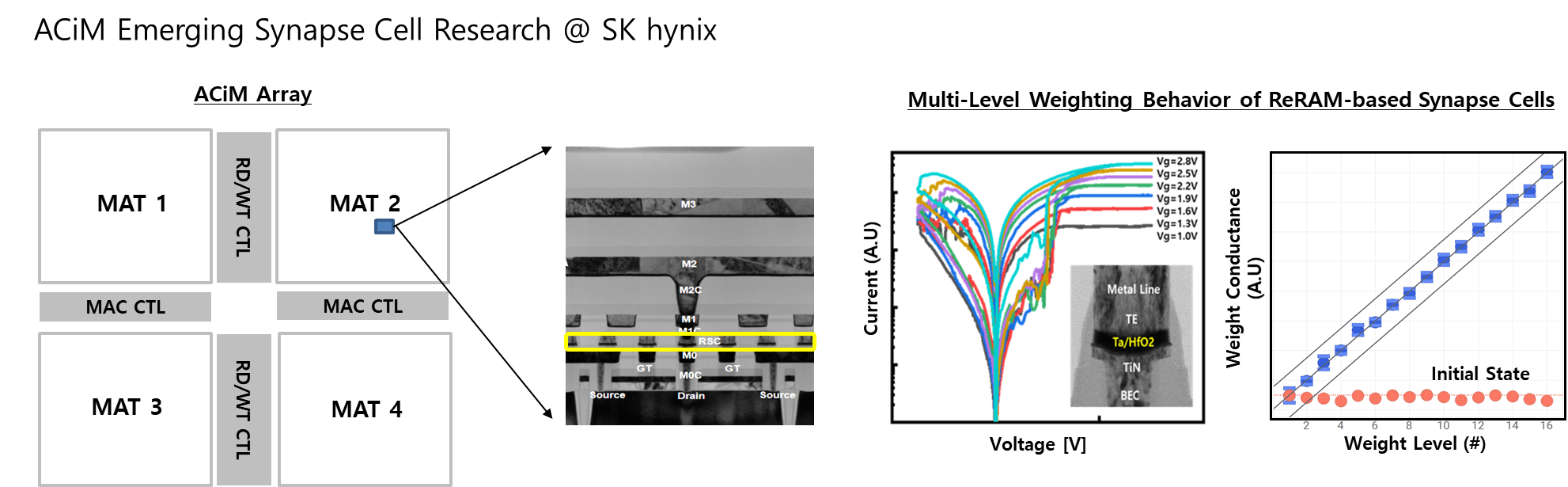
Finally, we also think emerging memory may be critical for the path for Beyond Memory by breaking the boundary between compute and memory. Emerging memory-based “analog-compute in memory” (ACIM) has been of great interest both in academia and industry as a path to energy efficient AI accelerators for next generation computing. Emerging memory has the potential for simultaneous compute-and-store due to their non-volatile memory characteristics. Therefore, ACIM has been widely evaluated in academia and the industry in recent years. This includes RTC, where we are evaluating this option since ACIM cells have many commonalities with known memory cells while its unique optimization such as linearity exists. We have successfully demonstrated 16 levels of RRAM-based Synapse cells platform with good set/reset characteristics which are embedded in a CMOS technology. We are starting to obtain interesting results with these cells, and we hope to be able to share these with the community in the near future.
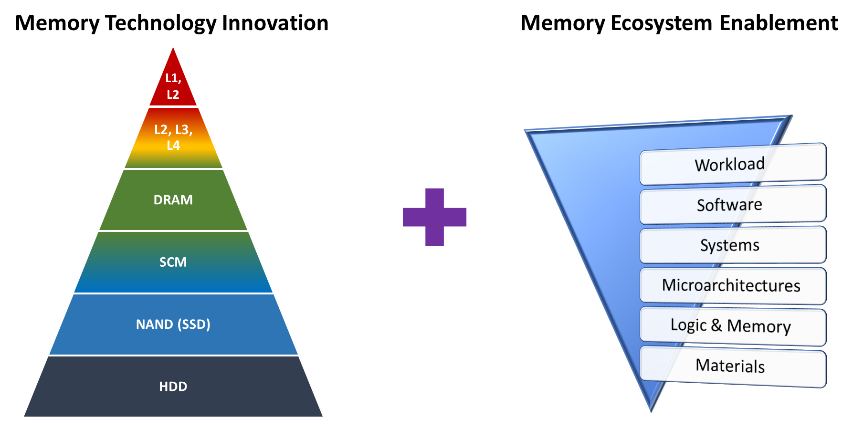
Although many opportunities exist in emerging memory technology, it needs to be stressed that the introduction of new memory requires a whole new memory ecosystem. The introduction of emerging memory is truly a testcase of System-Technology-Co-optimization (STCO) no matter whether exploring CXL memory or Beyond memory. To make the opportunities of emerging memory into reality, building a new memory R&D ecosystem and working together across the ecosystem will play a critical role to move beyond memory-wall issues in current Von-Neumann computing architectures toward next generation computing.
Therefore, we deeply believe that the journey of memory innovation toward next generation computing is only possible if all companies and academic institutions which are part of the memory ecosystem collaborate to address the various issues in current computing. As Hillary Clinton once said: "It takes a village to raise a child". This is also true for semiconductor research.
![[Summary] A Memristor-based In-Memory Computing SoC with Efficient Depthwise Convolution](https://mis-prod-koce-research-user-cdn-01-blob-ep.azureedge.net/web/blog/20260806/thumb_sEVmfv3K.20260806085519833.jpg)
![[Insights] Evolving Role of Emerging Memories in Next-Generation Computing](https://mis-prod-koce-research-user-cdn-01-blob-ep.azureedge.net/web/blog/20260806/thumb_NgJoNLYn.20260806080458980.jpg)
![[Summary] Electrical Characteristics of the 4F2 Vertical Gate (VG) DRAM integrated with Bit-Line Shielding (BLS) and Back Gate (BG) Transistor](https://mis-prod-koce-research-user-cdn-01-blob-ep.azureedge.net/web/blog/20260806/thumb_DOUurl5m.20260806080624234.png)